
Hummus. Pronounced HOOM-uhs. Served as a meal. Warm. With no utensils but a pita. Simple yet completely complex. A political dish, compete with a rich, dated history.
Before I came to this country, I constantly heard the words “stay safe” or “be careful” more times than I could count. The news scared people, quite frankly it scared me a bit too. The media back home represents the Israeli-Palestinian conflict as a violent war torn mess, and although it is dangerous and deadly, I only see a version of this conflict when the celebrated chickpea dish is mentioned.
The Israeli-Palestinian conflict is simply a conflict over territory, over power, between two groups of people with little compromise in sight. This conflict started long long before I was even a thought, but what we see in the news today began much more recently. The desire to re-establish a Jewish state in the territory defined as the historic land of Israel intensified after Word Was II. The one problem being that other cultures and religions existed in this land. Arab Muslims in particular were forced out and in 1948 the conflict culminated in the Arab–Israeli War. A war called the “War of Independence” by Jews and “Nabka” or catastrophe by the Arabs. 700,000 Palestinians were forced out of their homes, but many remained. By 2013 Israel’s Central Bureau of Statistics estimated the Arab Israeli population was over 1.6 million (not including the Palestinian territories of Gaza and the West Bank), or about twenty per cent of Israel’s population.
What I didn’t know until I arrived here was that the most powerful party involved – the United States – has consistently sided with Israel over the Palestinians. President Trump recently moved the U.S. Embassy to Jerusalem, which symbolically signifies an Israeli position over Palestinians and the end of the “two-state” solution. This I learned on the plane when my neighbor, a Jewish man from Jerusalem, apparently was a huge Trump supporter. Something I was extremely surprised to hear, as my previous travels did not grant such kind words. Ask my British relatives about Trump and you will certainly hear something quite different.
We hear about the casualties in the news, about the 3,000 Palestinian and 1,000 Israeli casualties, about the suicide bombings. This is all that the media shows. I know there is danger, but I don’t necessarily see it. I see a silly patriotic debacle over a traditional dish.
Yes, I brought up politics at the dinner table. I am sorry, but it seemed necessary as I tell the story of hummus and my experiences with it here in Israel. Just as I said, this is a political dish. There is a huge debate throughout the Middle East as to who invented hummus. Who has better hummus, and who can claim it as their own. In the running for this includes Israel, Lebanon, Syria, and Egypt. In Israel the debate is whether or not the dish is Jewish or Arab. Israeli or Palestinian? Who makes it better? Jews or Arabs? There is even intense debate about which Arab shop has the best hummus.
So for me I see a conflict, but not one that involves violence, but more of a passionate playground bicker about who gets to call hummus their own. One that culminates in a contest of who can set the Guinness World Record for the largest bowl of hummus. Which Lebanon holds with a massive 10,450-kilo dish that just beat out Israel’s comparably weak attempt of 4,082 kilos. That’s 9,000 pounds for you Americans, Liberians, and Burmese out there.
Jews argue that it’s a Jewish food, mentioned in the bible 3,500 years ago. It is in the Book of Ruth, part of the third and final section of the Hebrew Bible: “Come hither, and eat of the bread, and dip thy morsel in the hometz.” But Palestinians, Syrians, Lebanese, and Egyptians make a strong case too. It is simply a patriotic debate, one in which each side has strong evidence, each side accuses the other of cultural appropriation. A silly, amusing, but surprisingly heated debate. It is silly to try and determine who “owns” a dish this old, as that is simply impossible. With a bit of research into one dish, you discover 10 other dishes that are quite similar, using the same techniques and ingredients, just in a different location.
Regardless of where this dish originates, regardless of whose recipe is best, there is a common ground, and that is to enjoy the dish. And enjoy it often.
That I certainly have done!
In this so-called “fractured” state, Hummus has shed light on the unity and the sense of community that is present here. Israel is defined by its hummus. Jews and Arabs alike treasure this dish and come together to agree that it belongs to this land, regardless of who is in control of it. Although there is debate about who makes it the best, it is agreed that it is the “bread and butter” of this land.
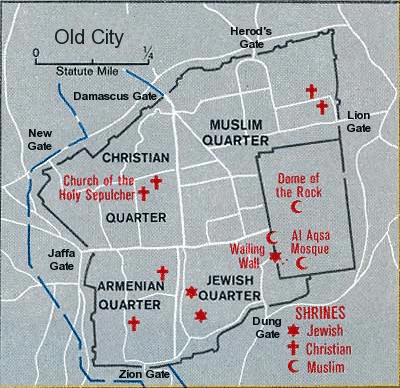
In Jerusalem especially, the city is divided between the separate religions, there is a Jewish Quarter, Christian Quarter, Muslim Quarter, and Armenian Quarter. There are too many cultures and subcultures to even begin to count and local cuisine is impossible to define. It is in this city that I see the zealous effort to protect ones land and culture and it is here that intolerance is more visible. But it is also here that I see hummus as a method of breaking down boundaries. In Jerusalem, a religiously divided city, you can witness Jews eating hummus in the Muslim Quarter, being served with the same spirit of warmth and generosity that all customers are greeted with. It is common to see a man in a Kippah (yamaka) in the Muslim quarter of Jerusalem, dipping his pita in a perfect bowl of Arab-style hummus.
Israel is a country with a fascinating spiritual and emotional energy that sometimes culminates in intolerance and violent conflict. It is a land where resolution is tricky and no one seems to be willing to concede for fear of loosing “their” land. But I see hope. A hope that stems from one unifying force, food. My question is, can hummus bring everyone together?
The quest for the “best hummus” has become a popular Israeli sport. Noting the subtle differences has become a skill. Ask a local about the best hummus in their city and you will be in for a passionately expressed opinion.
I have heard the comparison that hummus is like the “peanut butter” of America, or the “Nutella” of Europe. It is absolutely true.
The hummus you see at home however, is not hummus. It is not meant to be mass produced and stored in a plastic tub in the refrigerator aisle. It is not an appetizer, not a dip that you have with carrots. It does not come in roasted red pepper flavor, avocado, or sun dried tomato pesto. No. It is much, much more than that. But also in some ways so much less than that.
Think warm bowl of hummus with toppings galore. No frills. No special service. Straight to the point. The hummus experience is simply a celebration of the legume. This is not a pretty dish and it is not meant to be. No need to spice up this pale pasty legume of magic by adding fancy garnish. No need for forced restaurant ambiance. The ambiance is in the casual environment and the plate of sloppy hummus to mow through.
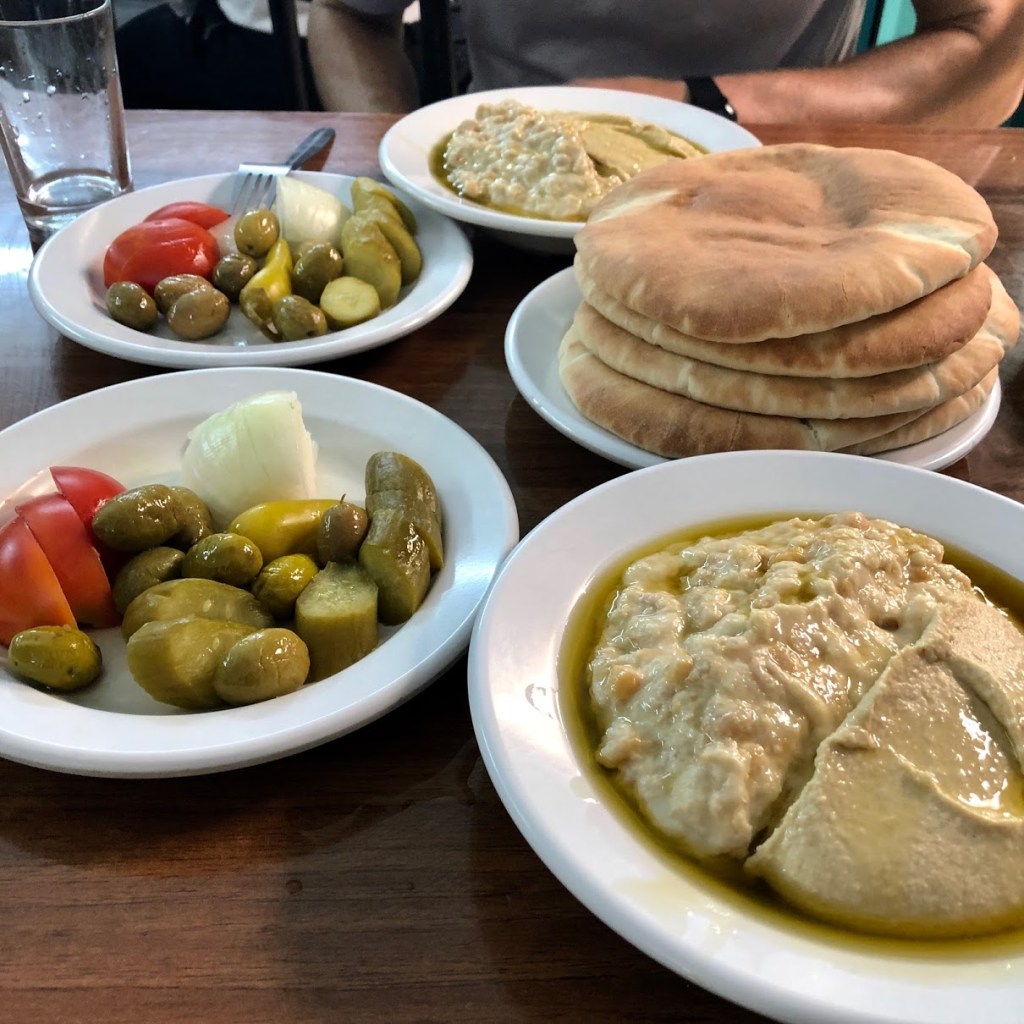
The only way to experience this authenticity has to be by sitting down at a small, initially unappealing to the eye, hummisya (shop specializing in hummus). The best way to understand this local practice is to watch those around you. Look for the locals. The ones that walk in like they own the place, sit down, order immediately, and have creamy goodness in front of them within moments. The ones who don’t bother to use napkins or finish their mouthful before talking. They know the ropes.
I will admit that I have given the supermarket hummus aisles many, many visits. How could you not when they are this full of every style, consistency, and brand you could imagine. You can stalk your fridge with pretty mediocre hummus that does the trick when the authentic hummus leftovers are finished off. Not quite the best stuff, but much better than what we have in America.

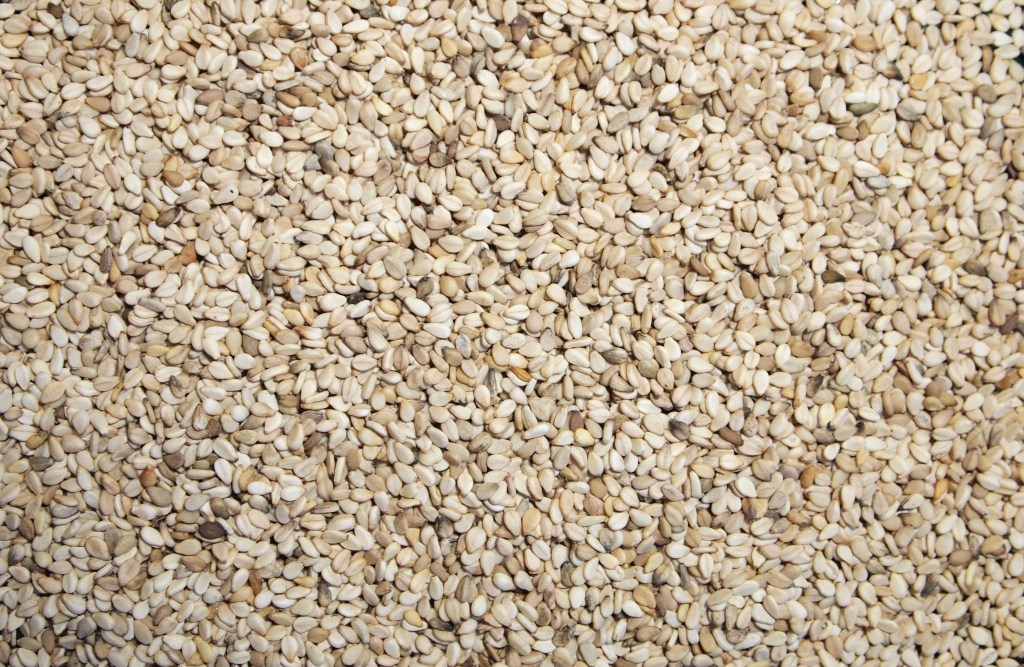
Authentic Hummus is quite simple. People may not agree on the origin, but it is agreed that the ingredients include chickpeas, tahini sauce, garlic, baking soda, salt, and lemon. Nothing else. Again adding to the no frill, but still so much thrill testament of hummus. As a player in this passionate Israeli sport, I am practicing my skills so that I can notice the differences in each dish. Some are thicker, some are whipped and fluffy, tart with lemon, saltier, some have herbs in the mixture, and some are pureed warm. All stemming from the recipe’s ratio of chickpeas to tahina and the pounding techniques of the chickpeas.
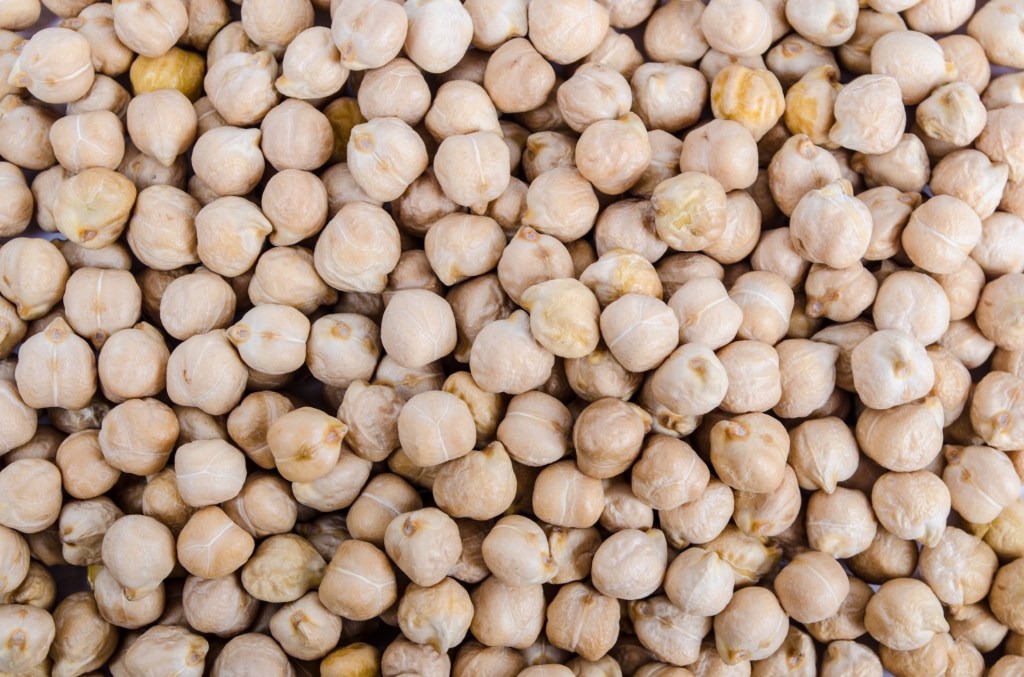
There are a few variations of hummus I have become acquainted with here in Israel. Plain, hummus tehina, which comes with a big scoop of tahini on top, hummus with hummus (the arabic word for chickpea is also hummus) and masabacha, a slight variation where the chickpeas are cooked longer and remain more whole giving a bit more texture to the mixture. This I can only recognize on menu’s when they label it using “1/2” for half ground instead of the full name. Thank goodness the hebrew language uses the same symbols for numbers.
From there you can find an assortment of toppings to keep it interesting, but you can only choose one. A generous topping of the best olive oil you have ever tasted, lemon juice, ful (fava beans), ground meat (sometimes veal, lamb, beef, or chicken), pitriot (sautéed mushrooms), or beitzah (hard boiled egg). Some apparently less common and more hip establishments offer grilled onions, almonds, pine nuts, or walnuts. On average, Israelis consume about 10 kilos of hummus a year. Now I see why.
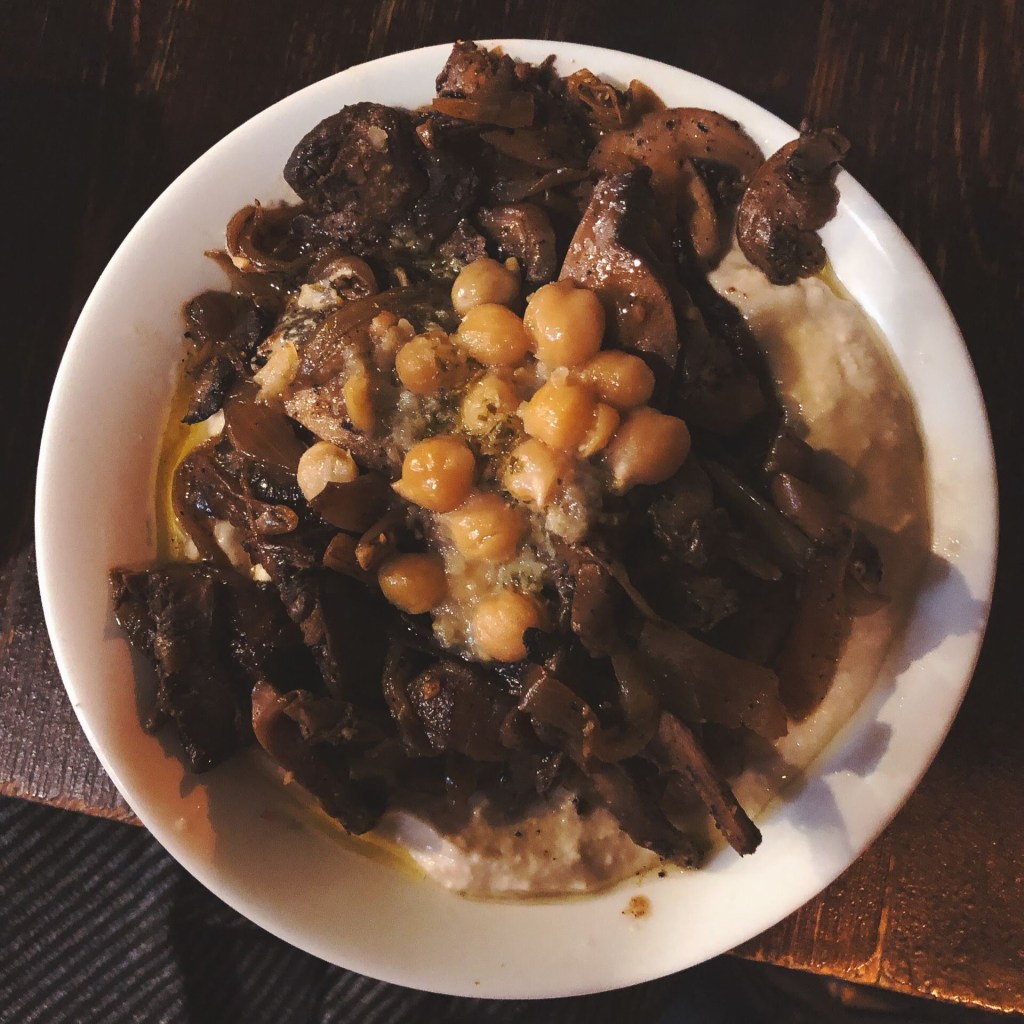
Hummus with mushrooms 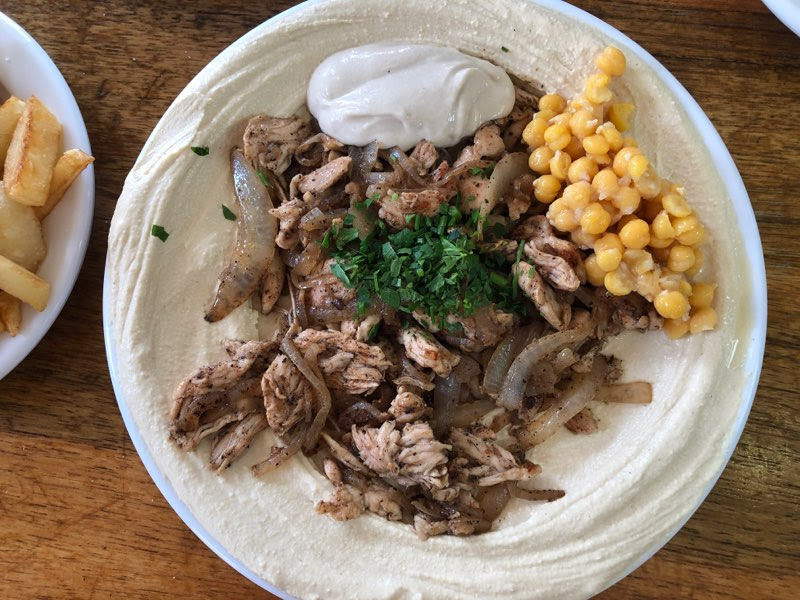
Hummus with chicken 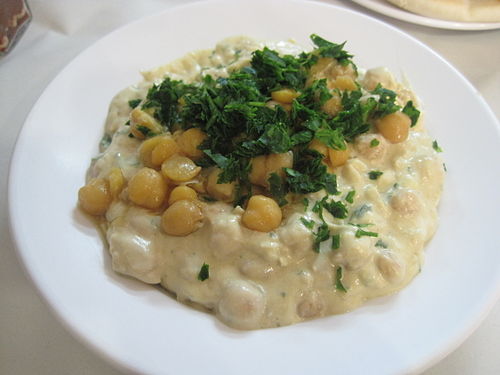
Masabacha 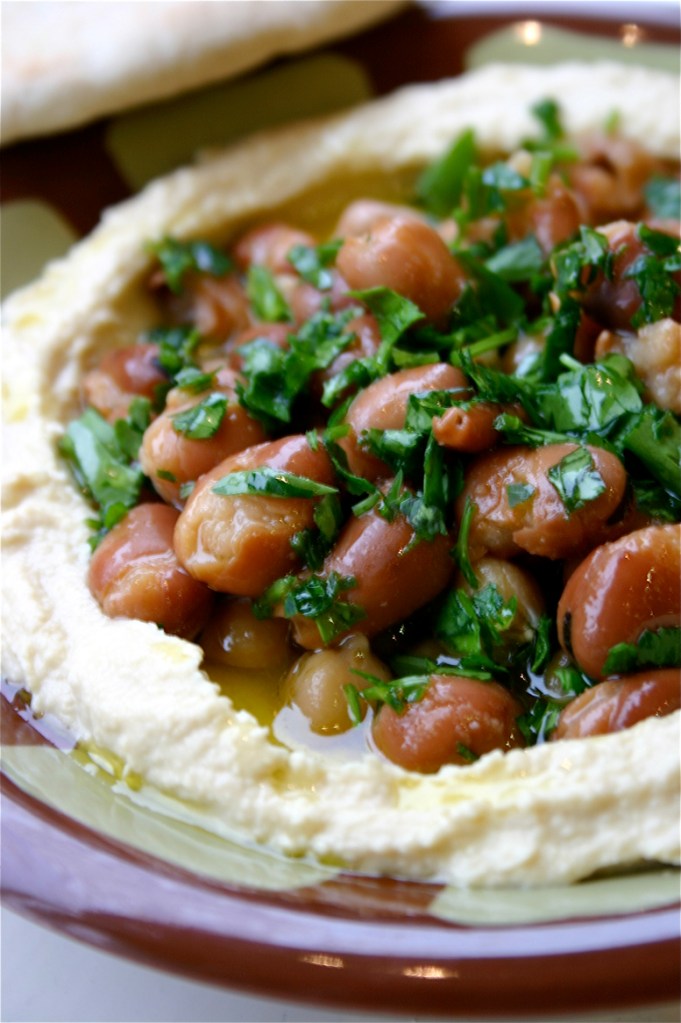
Hummus ful 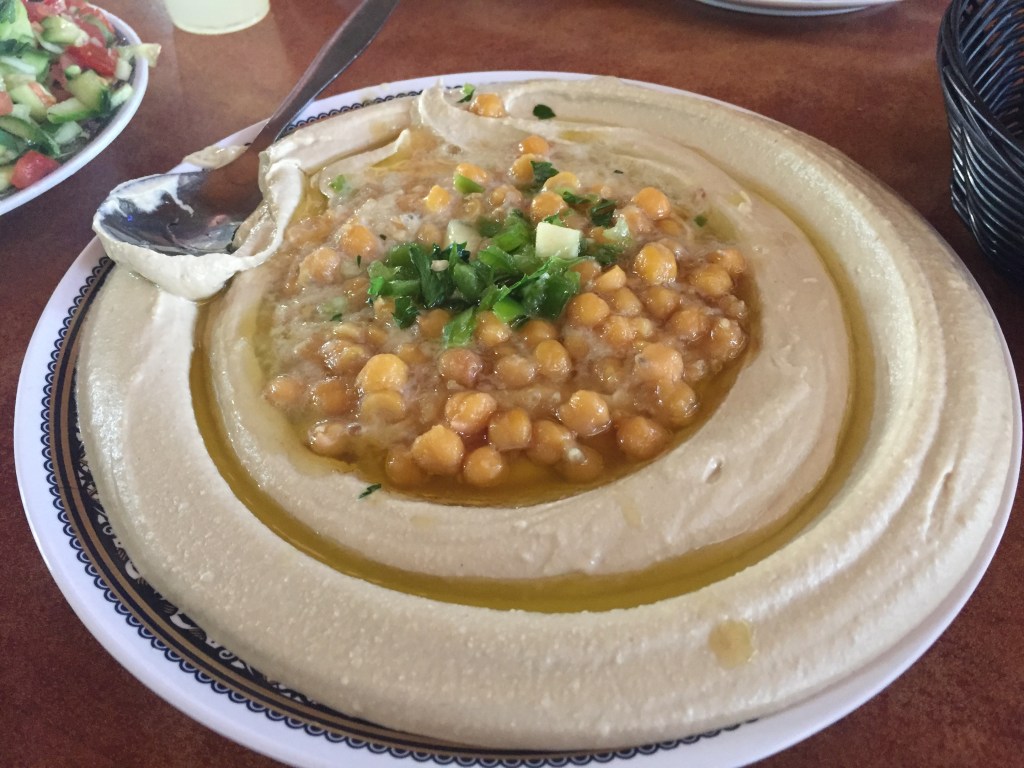
Hummus with hummus
I consumed hummus absolutely wrong for many years. I thought Trader Joes was the birth place of hummus, carrying my favorite eggplant or roasted garlic variations. In my pursuit to right my wrongs, I have made it a mission to experience hummus the way it “should” be. I set out to experience hummisyas around Israel. Not to determine who has the best hummus, who hummus belongs to, but to truly understand the cultural experience that this dish offers and to see its unifying potential.
Hummus is a delicious and nutritious dish that has much to offer the world. I have certainly gotten caught up in its magic. Hummus is made by love. It relies so much on history, but also encapsulates hope for the future. It is a culture that brings people together, cultivates passion, and creates friendships. It is humanity. So on that note I set out to experience this culture, to learn about its tradition and to see the future. To witness humanity. And simply, to taste hummus.
בתאבון = beh’teh av’own = bon-apetit
References
Kamin, D., Bohstrom2, P., Inbaryesterday, E., Lis3, J., Harel5, A., Benjakob20, O., … Haaretz. (2018, April 10). Tourist tip #201 / Eating hummus like a local. Retrieved from https://www.haaretz.com/israel-news/travel/.premium-tourist-tip-201-eating-hummus-like-a-local-1.5236429
Galili, S. (2012, April 27). Land of hummus and pita. Retrieved from https://www.ynetnews.com/articles/0,7340,L-3401347,00.html
Rosenthal, A., Pelʼi-Bronshṭain Orli, & Alexander, D. (2019). Al-Ḥummuṣ = Hummus: on the Hummus Route a journey between cities, people, and dreams = Ḥumus. Paris, France?: Magica.
(2014, October 1). Retrieved from http://edition.cnn.com/travel/article/food-fights/index.html
(2018, November 7). The Israeli-Palestinian conflict explained. Retrieved from https://www.sbs.com.au/news/the-israeli-palestinian-conflict-explained_2
 Travels With Charlie